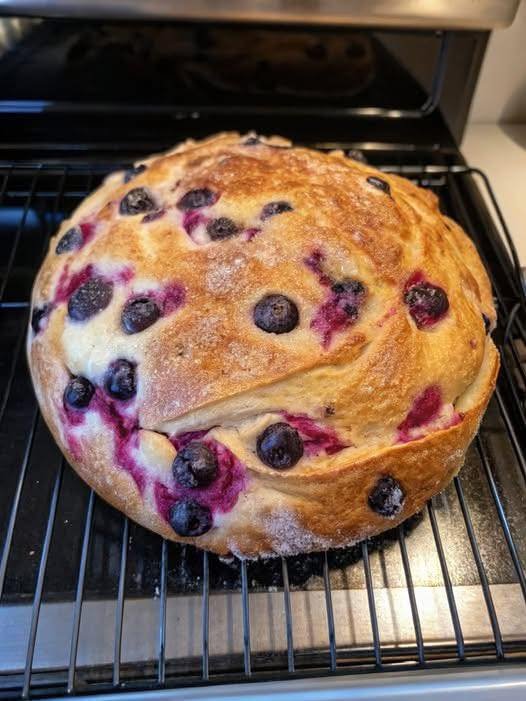
Prep Time: 45 minutes (hands-on)
Bulk Fermentation: 4 – 8 hours
Cold Proof: 12 – 16 hours
Bake Time: 50 minutes
Total Time: 18 – 26 hours (mostly hands-off)
Recipe Intensity: Advanced (Requires an active sourdough starter and bread-making experience)
Equipment
-
Digital Kitchen Scale (essential for accuracy)
-
Medium Mixing Bowl
-
Bench Scraper
-
Banneton Proofing Basket (or a bowl lined with a floured tea towel)
-
Dutch Oven (with a lid)
-
Razor Blade or Lame for scoring
Ingredients
For the Main Dough:
-
500g Bread Flour
-
350g Water (room temperature, ~70°F/21°C)
-
100g Active, Bubbly Sourdough Starter
-
10g Fine Sea Salt
-
Zest of 2 large Lemons
For the Fillings:
-
150g Fresh Blueberries (rinsed and thoroughly dried)
-
120g Full-Fat Cream Cheese, cold, cut into ½-inch cubes
-
Optional: 1 tablespoon of all-purpose flour for dusting the blueberries
Instructions
Day 1: Mixing & Bulk Fermentation
Step 1: Autolyse (Resting the Flour)
Approximately 30 minutes before your starter peaks, combine the 500g of bread flour and 350g of water in your mixing bowl. Mix with your hands or a spatula until no dry bits remain. It will be a shaggy mass. Cover the bowl and let it rest for 30-60 minutes. This process, called autolyse, allows the flour to fully hydrate, making the dough easier to work with and improving its final structure.
Step 2: Incorporate Starter and Salt
Add the 100g of active starter and the lemon zest to the top of the autolysed dough. Use wet hands to dimple and pinch the starter into the dough until it is relatively incorporated. It will be messy at first, but persist. Let it rest, covered, for 20 minutes.
After this rest, add the 10g of salt. Sprinkle it over the dough and use a splash of water to help incorporate it. Continue to pinch and fold the dough until the salt is fully mixed in.
Step 3: Bulk Fermentation & Coil Folds
This is the critical rising period. Over the next 3-5 hours (timing is highly dependent on your kitchen’s temperature), you will perform a series of “coil folds” to build strength in the dough.
-
Coil Fold Technique: Wet your hands, then slide them under the center of the dough in the bowl. Gently lift the dough upward, allowing it to stretch, and then fold it over itself. Rotate the bowl a quarter turn and repeat 3-4 times until you’ve folded all sides.
Perform your first set of coil folds 30 minutes after incorporating the salt. Repeat this process 3-4 more times, spacing the folds by 30-45 minutes. You will feel the dough become smoother, stronger, and more elastic.
Step 4: Laminating in the Fillings
About halfway through bulk fermentation, after 2-3 sets of folds, it’s time to add the fillings. Lightly mist your counter with water and gently turn the dough out onto it. Using wet hands, gently stretch the dough into a large, thin rectangle (about ½-inch thick).
-
Scatter the dried blueberries evenly over the surface.
-
Dot the surface with the cold cubes of cream cheese.
Now, like folding a letter, gently fold one-third of the dough from the top to the center, then the bottom third up and over. Then, fold the left and right sides into the center. The goal is to encase the fillings in layers. Return this parcel of dough to the bowl, seam-side down.
Step 5: Final Bulk Fermentation
Continue with 1-2 more gentle coil folds if the dough feels strong enough, being careful not to crush the blueberries. Then, let the dough rest, covered, for the remainder of bulk fermentation. The dough should look puffy, have risen by about 30-50%, and be full of air bubbles.
Day 1 (Evening) & Day 2: Shaping & Baking
Step 6: Pre-shape and Bench Rest
Gently turn the dough out onto an unfloured counter. Using a bench scraper, gently form it into a loose round. Let it rest, uncovered, for 20-30 minutes. This relaxes the gluten for the final shape.
Step 7: Final Shaping
Lightly flour your counter and the top of the dough. Gently flip it over so the floured side is down. Shape the dough into a tight boule (round) or batard (oval). Be firm but gentle to avoid bursting the fruit and cheese. Place the dough, seam-side up, into a well-floured banneton.
Step 8: Cold Proof
Cover the banneton with a plastic bag and immediately place it in the refrigerator for 12-16 hours. This long, cold fermentation develops incredible flavor and makes the dough easier to score.
Step 9: Baking
Preheat your oven with the Dutch oven inside to 450°F (230°C) for at least 45 minutes.
Remove the banneton from the fridge. Place a piece of parchment paper over the top and carefully flip the dough out onto it. The dough should hold its shape.
Score the top of the loaf with a razor blade. A simple single slash or a decorative pattern will allow steam to escape and the loaf to expand beautifully.
Carefully remove the preheated Dutch oven, place the dough (on the parchment) inside, put the lid on, and return it to the oven.
-
Bake covered: 25 minutes
-
Bake uncovered: 20-25 minutes, or until the crust is a deep, golden brown.
Step 10: Cool Completely
This is non-negotiable! The bread is still cooking internally, and the structure is setting. Let the loaf cool on a wire rack for at least 3-4 hours before slicing. Slicing too soon will release steam and make the crumb around the fruit and cheese gummy.
Serving Suggestions
This bread is a masterpiece on its own, sliced thick and enjoyed with a pat of good butter. It makes exceptional French toast, or can be lightly toasted and served with a drizzle of honey. It pairs wonderfully with a cup of tea or coffee.
Nutrition Information
Important Disclaimer: The following nutrition facts are estimates based on the specific ingredients and brands used. Values can vary significantly.
Serving Size: 1 slice (approx. 1/12th of the loaf)
| Nutrient | Amount (Estimated) |
|---|---|
| Calories | ~ 245 kcal |
| Total Fat | 5 g |
| Saturated Fat | 3 g |
| Cholesterol | 13 mg |
| Sodium | 340 mg |
| Total Carbohydrates | 42 g |
| Dietary Fiber | 2 g |
| Sugars | 3 g |
| Protein | 8 g |
The Nutritional Profile
This loaf is first and foremost a celebratory bread, but its sourdough base offers unique benefits. The natural fermentation process involved in sourdough can pre-digest some of the starches and gluten, potentially making it easier to digest for some people compared to commercial yeast breads. It also has a lower glycemic index than standard white bread, meaning it causes a slower, more gradual rise in blood sugar.
The inclusion of blueberries adds a touch of dietary fiber and a wealth of antioxidants. The cream cheese contributes fat and protein, which adds to the feeling of satiety. While not a low-calorie food, this bread is a nutrient-dense and satisfying option that turns a simple carbohydrate into a complex and fulfilling culinary experience.