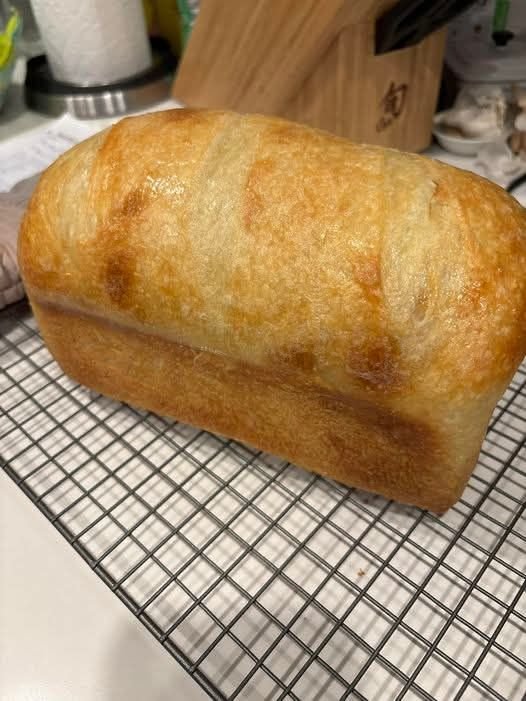
Experience the magic of sourdough in its most versatile and comforting form. This loaf yields a soft, tender, and slightly springy crumb with a golden-brown crust that’s pliable enough for perfect sandwiches. The natural fermentation from your sourdough starter imparts a gentle, complex tang that is far superior to any commercial yeast bread. This is your go-to, everyday sourdough that makes exceptional toast, unforgettable PB&Js, and simply divine avocado toast.
Prep Time: 30 minutes (active)
Rise Time: 8-12 hours (bulk fermentation) + 2-3 hours (final proof)
Bake Time: 40-45 minutes
Total Time: ~12-18 hours (mostly hands-off)
Intensity Level: Intermediate (requires basic sourdough knowledge)
Yield: One 9×5-inch loaf
Ingredients
For the Levain (Pre-ferment):
-
60g (½ cup) active, bubbly sourdough starter (100% hydration)
-
60g (½ cup) bread flour or all-purpose flour
-
60g (¼ cup) lukewarm water
For the Main Dough:
-
All of the prepared levain (about 180g)
-
360g (1 ½ cups) lukewarm whole milk (or water for a less rich loaf)
-
25g (2 tbsp) honey or granulated sugar
-
40g (3 tbsp) unsalted butter, softened, plus extra for greasing
-
500g (4 cups + 2 tbsp) bread flour (all-purpose works, but bread flour is ideal)
-
9g (1 ½ tsp) fine sea salt
-
Neutral oil (like avocado or vegetable) for coating the bowl
For Finishing:
-
1 tbsp melted butter or milk, for brushing (optional)
Instructions
Day 1: Evening (or Morning) – Create the Levain
-
Mix: In a small jar or bowl, combine the 60g active starter, 60g flour, and 60g lukewarm water. Stir until no dry flour remains.
-
Ferment: Cover loosely and let it ripen at room temperature (70-75°F / 21-24°C is ideal) for 4-6 hours, or until it is very bubbly, has visibly expanded (nearly doubled), and passes the float test (a small spoonful dropped in water floats). You can also let it ferment overnight for 8-12 hours at a cooler temperature. Once ripe, use immediately or refrigerate for up to 24 hours.
Day 2: Mixing & Bulk Fermentation
-
Autolyse (Optional but Recommended): In the bowl of a stand mixer or a large mixing bowl, combine the bread flour and lukewarm milk. Mix with a dough hook or spatula until no dry flour remains—it will be a shaggy mass. Cover and let it rest for 30-60 minutes. This hydrates the flour and begins gluten development.
-
Mix the Dough: Add the ripe levain, honey (or sugar), and softened butter to the autolysed flour mixture. Using the dough hook on low speed (or by hand with a sturdy spoon), mix until everything is incorporated, about 2-3 minutes. Scrape down the sides of the bowl.
-
Incorporate Salt: Sprinkle the salt over the dough. Mix on medium-low speed for 6-8 minutes (or knead by hand for 10-12 minutes) until the dough is smooth, elastic, and pulls away cleanly from the sides of the bowl. It should pass the windowpane test: gently stretch a small piece of dough; it should be thin enough to see light through without tearing immediately.
-
First Rise (Bulk Fermentation): Lightly oil a clean, large bowl. Place the dough in the bowl, turning it to coat lightly in oil. Cover tightly with a damp kitchen towel, beeswax wrap, or plastic wrap.
-
Let it Ferment: Let the dough rise at room temperature for 8-12 hours. The time is highly dependent on your kitchen’s temperature. The dough is ready when it has increased in volume by about 50-75% (not necessarily doubled), looks puffy, and shows bubbles just beneath the surface when you gently pull at it. This long, slow fermentation is key to the flavor and texture.
Shaping & Final Proof
-
Prepare the Pan: Thoroughly grease a 9×5-inch loaf pan with butter.
-
Shape: Turn the risen dough out onto a very lightly floured surface. Gently pat it into a rough rectangle, about 8×10 inches. With the short side facing you, fold the top third down towards the center, then fold the bottom third up over it (like a business letter). Pinch the seam to seal. Rotate 90 degrees, then roll the dough tightly into a log from the short end. Pinch the final seam and ends closed.
-
Place in Pan: Place the shaped loaf, seam-side down, into the prepared loaf pan.
-
Final Proof: Cover the pan loosely with the same towel or plastic wrap. Let the dough rise again until it crowns about 1-1.5 inches above the rim of the pan. This can take 2-4 hours at room temperature, depending on temperature and starter activity. To test, gently poke the dough with a floured finger; the indent should spring back slowly, leaving a slight impression.
Baking
-
Preheat: At least 30 minutes before baking, place a rack in the center of your oven and preheat it to 375°F (190°C).
-
Score & Bake (Optional): Just before baking, you can make one shallow slash lengthwise down the center of the loaf with a sharp knife or lame to control expansion. This is optional for soft loaves but helps with an even rise.
-
Bake: Place the loaf pan in the oven and bake for 40-45 minutes. The bread is done when it has a deep golden-brown crust, sounds hollow when tapped on the bottom (carefully tip it out of the pan to check), and the internal temperature registers 190-200°F (88-93°C) on an instant-read thermometer.
-
Butter Wash (Optional): For a supremely soft, glossy crust, remove the loaf from the pan immediately after baking and brush the top and sides with the optional melted butter or milk.
Cooling – THE CRUCIAL STEP
-
Remove from Pan: Let the bread cool in the pan for 5 minutes, then carefully turn it out onto a wire rack.
-
Cool Completely: Resist all temptation! You must let the bread cool completely for at least 3-4 hours before slicing. Slicing into hot bread traps steam and results in a gummy, dense crumb. The structure sets as it cools. Your patience will be rewarded with the perfect, sliceable texture.
Storage & Lasting
-
Room Temperature: Store the completely cooled loaf in a bread bag or wrapped in beeswax wrap at room temperature for up to 4-5 days. The crust will soften over time, which is desirable for this style of bread.
-
Freezing (Recommended): For long-term storage, slice the cooled loaf, place parchment between slices if desired, and store in a freezer bag for up to 3 months. Toast slices directly from frozen.
-
Refreshing: To revive day-old bread, warm slices in a toaster or wrap the whole loaf in foil and warm in a 300°F (150°C) oven for 10-15 minutes.
Nutritional Information (Per 50g Slice, estimated, based on 20 slices per loaf)
-
Calories: ~125 kcal
-
Total Fat: 2g
-
Saturated Fat: 1g
-
-
Cholesterol: 5mg
-
Sodium: 180mg
-
Total Carbohydrates: 23g
-
Dietary Fiber: 1g
-
Sugars: 2g
-
-
Protein: 4g
Notes on Nutrition & Fermentation:
-
This nutritional estimate uses whole milk and honey. Using water and sugar will yield slightly different values.
-
The long, natural sourdough fermentation process has several potential benefits: it may reduce the bread’s phytate content, improving mineral bioavailability. It can also lower the glycemic index compared to quick-rise commercial yeast breads, leading to a more gradual rise in blood sugar.
-
The wild yeast and bacteria (lactobacilli) pre-digest some of the starches and gluten in the flour, which some people with mild gluten sensitivities find easier to digest. It also creates the distinctive, complex tangy flavor.
-
This bread contains no commercial yeast, preservatives, or dough conditioners, making it a wholesome, pure alternative to store-bought sandwich bread.